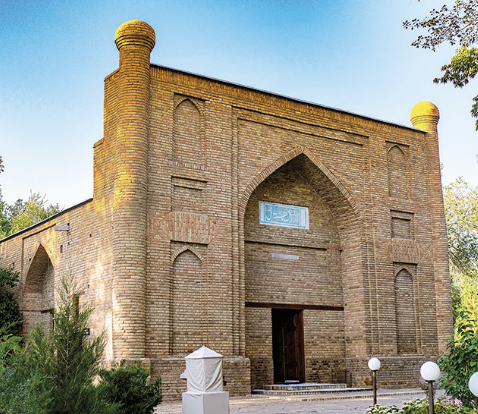
It was near the mausoleum of the legendary Khan
Karakhan, nicknamed «Aulie-Ata», after the ruinous
invasion of Genghis Khan and several centuries of
desolation, in the 30s of the XIX century, people began
to settle again, seeking patronage from the saint, after
whom the city of Aulie-Ata (now Taraz) was named in
1864.
The architectural monument of the Karakhanids era is
in the central part of Taraz and is part of a cult-memorial
complex within the territory of the medieval settlement.
The medieval structure has not been preserved in its
original form. Today, we can see this mausoleum in the
pictures of the second half of the XIX century and read
the memories of eyewitnesses. In 1906, the mausoleum
was somewhat rebuilt, but the bricks from the
Karakhanid era can still be seen inside the mausoleum,
on the dome, and in the arched niches.
Mazar is an elegant example of medieval art of building
and was erected, according to historians, in the XI
century by the same ruler who fell in love with Aisha,
the daughter of the famous scientist and poet of the XI
century Hakim Suleyman Bakyrgani. Karakhan himself
willed to bury himself in a place where he could see the
mausoleum of his deceased beloved, Aisha-Bibi.
The sad story about the beauty Aisha Bibi, her faithful
servant Babaji Khatun and the mighty Khan Karakhan
has several versions, and everyone in the Zhambyl
region knows it. Tourist guides will be happy to tell you
this story if you visit these sacred places
No responses yet